

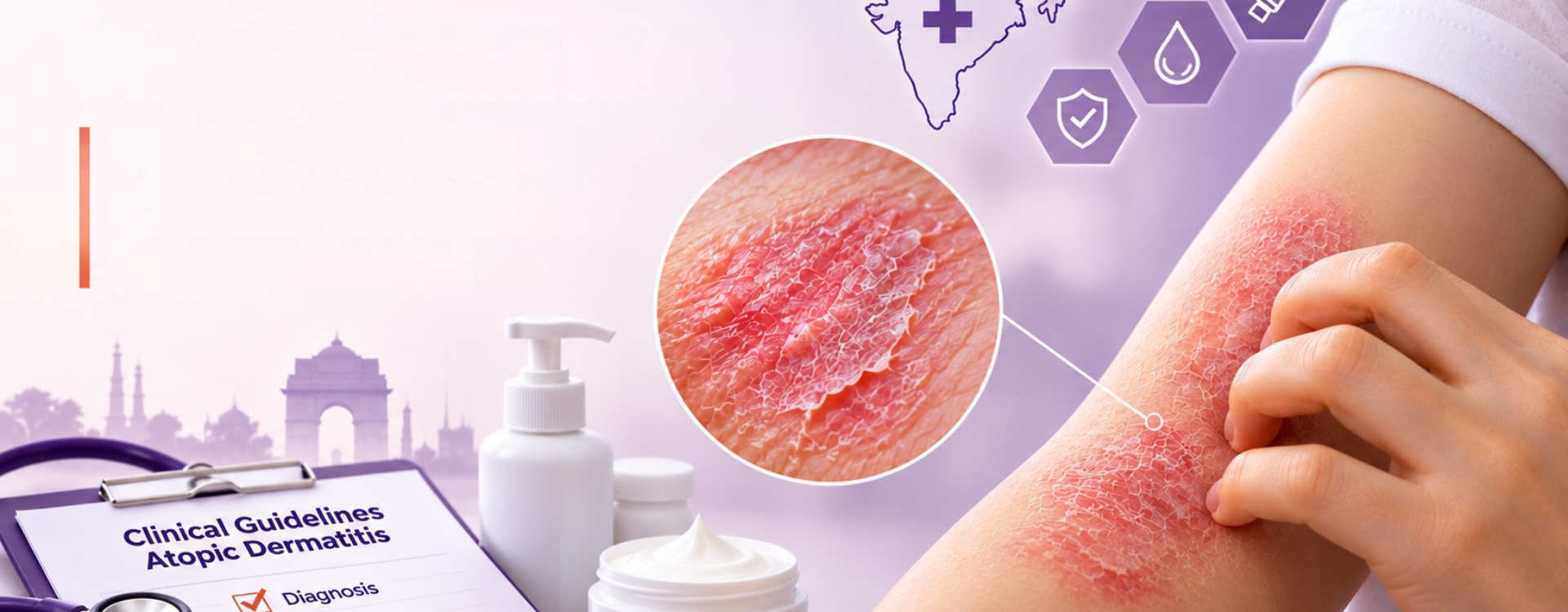
Atopic Dermatitis Management in India: What the Latest Clinical Guidelines Recommend
Atopic dermatitis (AD), commonly known as eczema, is a chronic inflammatory skin disease characterised by persistent itching, dry skin and recurrent episodes of inflammation. The condition can affect individuals across different age groups and may significantly impact sleep, daily activities and quality of life.
Although moisturisers and topical anti-inflammatory treatments remain important components of management, advances in dermatological research have expanded the available treatment options. These include topical targeted therapies, phototherapy, conventional systemic medications, biologics and Janus kinase (JAK) inhibitors.
In 2026, the Skin Allergy Research Society and the Society for Eczema Studies published updated guidelines for managing atopic dermatitis in India. The recommendations address treatment across age groups and special populations while considering local clinical needs, treatment accessibility and affordability.
The guidelines provide dermatologists and other healthcare professionals with an evidence-based framework for selecting appropriate therapies and improving long-term disease control.
Understanding Atopic Dermatitis and Its Impact
Atopic dermatitis involves a complex interaction between skin-barrier dysfunction, immune-system activity and environmental factors. An impaired skin barrier allows moisture to escape and makes the skin more susceptible to irritants and allergens. Inflammation further disrupts the barrier, contributing to a cycle of itching, scratching and recurring skin lesions.
Common clinical features include:
- Dry, sensitive skin.
- Persistent itching that may worsen at night.
- Redness, inflammation and eczematous lesions.
- Thickened skin resulting from repeated scratching.
- Recurrent flare-ups interspersed with periods of improvement.
The presentation can vary with age, disease severity and individual triggers. Infants may develop lesions on the cheeks and scalp, while older children and adults frequently experience involvement of the skin folds, hands, feet and other areas.
Effective management therefore requires more than addressing visible lesions. Treatment should also aim to control itching, restore the skin barrier, reduce flare frequency and improve quality of life.
An Individualised Approach to Atopic Dermatitis Management
The updated Indian guidelines emphasise that treatment should be tailored to disease severity, clinical presentation, patient age, associated conditions and previous treatment response.
Assessment may include clinical examination and validated tools such as the Eczema Area and Severity Index (EASI), SCORing Atopic Dermatitis (SCORAD), Patient-Oriented Eczema Measure (POEM) and Dermatology Life Quality Index (DLQI).
These measures help clinicians evaluate disease activity, understand its impact on patients and monitor treatment response over time.
The overall treatment objective is to achieve sustained disease control while minimising adverse effects and unnecessary treatment burden. Patients with moderate-to-severe disease that remains uncontrolled despite appropriate topical therapy may require specialist assessment for additional treatment options.
1. Topical Therapies: The Foundation of Disease Management
Topical treatments remain central to the management of atopic dermatitis, particularly in mild-to-moderate disease. Their selection depends on the affected body area, the degree of inflammation, patient age and treatment tolerability.
Moisturisers and Skin-Barrier Support
Regular moisturiser use is a fundamental component of atopic dermatitis management. By supporting skin hydration and reducing water loss, moisturisers help maintain barrier function and may reduce the frequency of flare-ups.
The updated Indian guidelines recommend consistent moisturiser use, generally at least twice daily, with more frequent application when required.
Moisturisers also have a steroid-sparing role, potentially reducing the need for repeated courses of topical corticosteroids. They should remain part of the management plan even when the skin appears clear.
Topical Corticosteroids
Topical corticosteroids help control inflammation during active flare-ups. Their potency, application frequency and duration should be selected according to disease severity, anatomical location and patient-specific considerations.
For patients who experience repeated flare-ups in the same areas, the guidelines also support a proactive maintenance approach. Under medical supervision, intermittent application to previously affected areas may help reduce recurrence after the acute inflammation has resolved.
Appropriate selection and monitoring are important, particularly when treating children or sensitive areas such as the face and skin folds.
Topical Calcineurin Inhibitors
Tacrolimus and pimecrolimus are topical anti-inflammatory agents that can be useful alternatives or adjuncts to corticosteroids in selected patients.
They are particularly relevant for sensitive areas where prolonged corticosteroid use may increase the risk of local adverse effects. The guidelines also discuss their role in proactive maintenance therapy for areas prone to recurrent inflammation.
Topical Crisaborole and JAK Inhibitors
Advances in topical treatment have introduced additional options for selected patients with mild-to-moderate atopic dermatitis.
Crisaborole is a phosphodiesterase-4 (PDE-4) inhibitor that helps regulate inflammatory signalling. The Indian guidelines recommend considering it for mild-to-moderate disease, including situations where corticosteroids or calcineurin inhibitors may be unsuitable.
Topical JAK inhibitors represent another targeted approach. They act on intracellular signalling pathways involved in inflammation. However, their availability, approved indications, application limits and long-term safety evidence vary by product and jurisdiction.
Treatment decisions should therefore reflect the relevant prescribing information and the patient’s clinical circumstances.
2. Phototherapy for Persistent Disease
Phototherapy may be considered for selected patients with chronic moderate-to-severe atopic dermatitis, particularly when conventional topical treatments do not provide adequate control.
Narrowband ultraviolet B (NB-UVB) is one of the modalities discussed in the Indian guidelines. It may help reduce inflammatory activity and disease severity through controlled ultraviolet exposure.
The choice of phototherapy depends on disease characteristics, treatment accessibility and the patient’s ability to attend repeated sessions. Potential risks and the need for appropriate supervision should also be considered.
Phototherapy is not necessary for every patient with atopic dermatitis. It is an additional option within an individualised treatment strategy.
3. Systemic Treatments for Moderate-to-Severe Atopic Dermatitis
When disease remains inadequately controlled despite appropriate topical treatment, clinicians may consider phototherapy or systemic therapy, depending on the patient’s needs.
The updated guidelines discuss conventional systemic immunomodulators, biologic therapies and oral JAK inhibitors. These options differ in their mechanisms of action, clinical evidence, monitoring requirements, safety considerations and accessibility.
Conventional Systemic Therapies
Cyclosporine, methotrexate and other immunomodulatory agents may be considered in selected patients with more severe or treatment-resistant disease.
The guidelines identify cyclosporine as an important conventional systemic option when newer licensed therapies are unavailable, unsuitable or financially inaccessible. Methotrexate may also be considered in appropriate cases with suitable monitoring.
These treatments require careful assessment because their potential adverse effects and monitoring needs differ. Prolonged systemic corticosteroid use is discouraged because of its unfavourable risk-benefit profile in chronic atopic dermatitis.
Systemic treatment should be initiated and supervised by an appropriately qualified clinician.
Biologic Therapy: Targeting Specific Immune Pathways
Biologic therapies have expanded the treatment landscape by targeting specific components of the immune response involved in atopic dermatitis.
Dupilumab targets the interleukin-4 receptor alpha (IL-4Rα), inhibiting signalling through interleukin-4 and interleukin-13 pathways. These pathways contribute to type 2 inflammation, a key component of atopic dermatitis pathophysiology.
Clinical evidence has demonstrated improvements in disease severity, itching and quality of life with dupilumab. The updated Indian guidelines recommend it as an important option for adults with moderate-to-severe disease and discuss its role in other patient groups.
Treatment selection should account for eligibility, associated conditions, safety considerations, availability and affordability. Ocular symptoms, including conjunctivitis, warrant attention during treatment, and patients with relevant pre-existing eye conditions may require additional assessment.
Other biologics, including tralokinumab, are also discussed in the international treatment landscape. Their regulatory status and availability in India must be verified before making treatment recommendations.
JAK Inhibitors: A Targeted Approach to Inflammatory Signalling
Janus kinase inhibitors offer another approach to controlling inflammation by interfering with intracellular signalling pathways involved in immune responses.
The Indian guidelines discuss oral agents such as abrocitinib and address the potential role of other JAK inhibitors in selected circumstances.
Abrocitinib, a selective JAK1 inhibitor, is highlighted as an option for eligible adults and adolescents with moderate-to-severe atopic dermatitis. The guidelines note that rapid improvement and relief from severe itching may be important considerations when selecting treatment.
However, JAK inhibitors are not interchangeable. Their indications, contraindications and monitoring requirements vary. Clinicians must consider factors such as infection risk, relevant medical history, laboratory findings and other potential adverse effects.
Some agents discussed in the guidelines may be off-label or unavailable for atopic dermatitis in India. Their inclusion in a clinical guideline should not be interpreted as universal regulatory approval.
4. Preventing Relapses Through Long-Term Management
Atopic dermatitis is a chronic condition, and improvement during an acute treatment course does not necessarily mean that the tendency towards inflammation has disappeared.
The updated guidelines discuss proactive therapy as a strategy for patients with recurrent flare-ups. After active inflammation has resolved, intermittent application of a prescribed topical anti-inflammatory treatment to previously affected areas may help reduce recurrence.
This approach differs from reactive treatment, which is initiated only after symptoms return.
Long-term management should also include:
- Consistent moisturiser use to support the skin barrier.
- Identification and avoidance of relevant irritants.
- Appropriate use of prescribed anti-inflammatory treatments.
- Monitoring of itching, sleep disturbance and quality of life.
- Regular review of treatment effectiveness and tolerability.
Food restriction should not be introduced routinely without a clear clinical indication. Similarly, topical or systemic antibiotics should not be used preventively in the absence of a clinical infection.
Follow-up allows clinicians to reassess disease activity and determine whether the current management strategy remains appropriate.
What Do the Updated Indian Guidelines Mean for Clinical Practice?
The 2026 recommendations reflect the evolution of atopic dermatitis management from symptom control alone towards a more comprehensive approach that considers inflammation, skin-barrier function, disease recurrence and quality of life.
Their value lies in bringing established treatments and newer therapeutic approaches into a framework tailored to the Indian context.
Three considerations are particularly important:
Individualised treatment selection: Disease severity, patient age, comorbidities, previous treatment response and personal circumstances should guide therapy.
Evidence and safety: Treatment decisions should account for the strength of supporting evidence, potential adverse effects and the need for monitoring.
Access and continuity of care: Treatment availability, affordability and adherence influence the feasibility of long-term disease control.
The guidelines also highlight the importance of specialist involvement when systemic therapy is being considered, helping ensure appropriate diagnosis, treatment selection and monitoring.
Conclusion
Advances in dermatological research have broadened the treatment options available for atopic dermatitis. Alongside moisturisers and established topical anti-inflammatory therapies, options such as crisaborole, phototherapy, biologics and JAK inhibitors may offer additional approaches for appropriately selected patients.
The updated Indian guidelines provide a framework for integrating these options into clinical practice while accounting for age, disease severity, safety, accessibility and individual treatment needs.
Ultimately, effective atopic dermatitis management requires a sustained, patient-centred approach that combines control of active inflammation with skin-barrier support, relapse prevention and regular assessment.
Source: